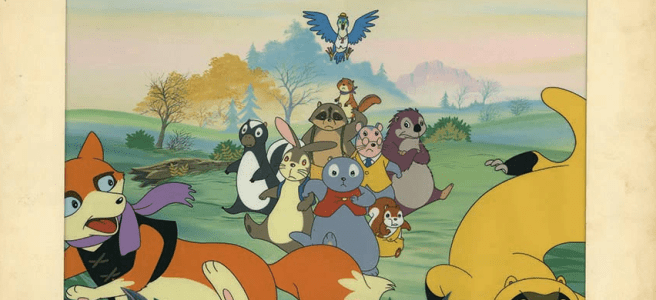
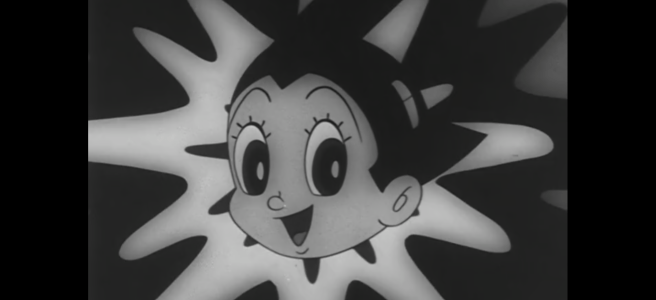
The World Masterpiece Theater entry for the year 1976, Marco, pushed studio Nippon Animation and the artists associated with it to their limits. As a result, the year 1977 was marked by disorganization, as most of Marco’s staff temporarily or definitively left the WMT, and the series for that year, Rascal the Raccoon, brought on new, possibly inexperienced, and simply less notable artists. This article will therefore not only focus on Rascal, but on two other works: the first is another Nippon show, Jacky the Bearcub, which counted among its staff most of Marco’s main artists: directors Isao Takahata and Seiji Okuda, and animators Toshiyasu Okada, Kôichi Murata, Reiko Okuyama and Yôichi Kotabe. The other is a completely different production, the first film by studio Shin-Ei, Tenguri, Boy of the Plains, which reunited Yasuo Otsuka and his students outside of Nippon Animation. Just a year before Future Boy Conan, 1977’s Rascal and Tenguri were the last works on which Hayao Miyazaki made significant contributions as a key animator. They therefore represent a turning point in his career, as well as that of all other artists who had been revolving around World Masterpiece Theater productions.
Tag: Yoshiyuki Tomino
The animation of Char’s Counterattack
When asked what was the biggest anime event of the year 1988, most people would surely answer Akira. Ghibli fans may note Grave of the Fireflies or My Neighbour Totoro. Only few people would mention one of the most ambitious entries in the Gundam franchise: Char’s Counterattack. Yoshiyuki Tomino’s third feature film project, and the first non-recap one, put an end to a story that had been going on for almost 10 years, the so-called “early Universal Century”. It was a turning point, not just for the Gundam series, but for anime as a whole - though this is rarely known or framed as such, since the movie is mostly only accessible to already experienced Gundam watchers. The goal of this article is to correct this state of affairs.
Heidi, Girl of the Alps
Heidi, Girl of the Alps needs no introduction. One of the most important and influential works in the history of Japanese animation, Isao Takahata’s first series for Zuiyo Video would set a gold standard for all subsequent World Masterpiece Theater entries. Much has already been said about Heidi, especially on its status as a so-called “pre-Ghibli” work or on how representative it is of Takahata’s style and philosophy. Considering the theme of this series, this article will instead put Heidi back in its historical context: that of the extended World Masterpiece canon, and of 1974 anime.
Yama Nezumi Rocky Chuck
Yama Nezumi Rocky Chuck, known in the English-speaking world as Fables of the Green Forest, can be considered the first show to fit into the extended World Masterpiece Theater canon: it was the first production of studio Zuiyo Video, which would become Nippon Animation, to take place in the consecrated Sunday 19:30 time slot on Fuji TV.
The History of TMS – 1 : The Birth of Anime
While today we speak of “the anime industry” like it’s something obvious, that wasn’t always the case. When animation started in Japan around the 1910’s, it was still very much a rudimentary process ; and even after WWII, with the creation of the first major Japanese studio, Toei Animation, things were still very different from now. In this first essay, I will show how anime became the “industry” we know today : an entire sector sharing common business practices and production processes. As I’ll do during the entire series, I’ll mostly focus on TV animation : the starting point will therefore be 1963, the generally accepted date of anime’s birth.