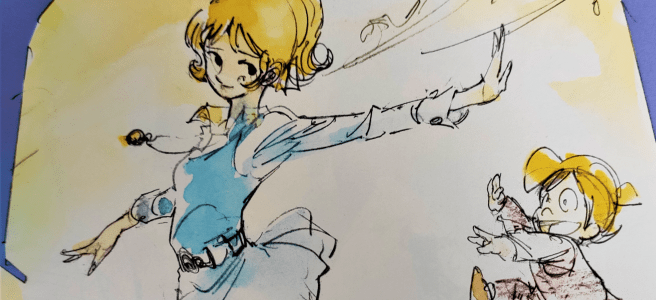
With this third artist spotlight dedicated to Shôichi Masuo, I’ll start analyzing the works of some animators who are not prominently affiliated with the Kanada school or style. Why do this? The main reasons are as follows: first, Masuo, just like all the other animators I’ll cover, has been in close contact with members of the Kanada school and his style can be understood in relationship with their own, whether in its continuity or contrast with it. Second, Masuo is one of the most important animators of the 80s and 90s, and a master of effects and mechanical animation. These are the fields Kanada and many of his followers specialized in during the same period, and it’s therefore worth understanding the more general context in which their own style developed. Finally, I believe Masuo is a forgotten figure in non-Japanese animation discourse, despite being one of the most important Japanese effects animators and one of the core staff members of Studio Gainax. The goal of this series is partly to highlight some less important figures, or underrated aspects of the work of more famous ones; I hope this article will help give Masuo some of the recognition he deserves.
Author: matteowatz
Graviton, Gainax, and the Itano school
Among all the artists influenced by Yoshinori Kanada, Ichirô Itano is probably one of the most important. And yet, he is never considered a Kanada-style animator, most likely because their styles look very different. One of the most important mechanical and effects animators of the 1980s, Itano revolutionized how SF anime would look, and his students, direct or indirect, scattered all over the industry. While it might seem to steer us a further away from Kanada, taking a look at what I call the “Itano school” is important, for two reasons. First, Itano himself was inspired by Kanada and many animators who followed him often took cues from the Kanada style. Second, taking a look at Itano’s students and their career is one of the best routes into the incredibly dense and rich field of the 80s: it’s easy to get lost among the many productions and studios birthed by the OVA boom.
Kanada and Tomonaga, 1978-1979
This article is an annex to this piece 1979 was no doubt a busy year in the anime industry, and especially so in the careers of Yoshinori Kanada and Kazuhide Tomonaga. From 1978 to 1979, the two men delivered some of their greatest work: for Kanada, it was on Daitarn 3, Cyborg 009 and Galaxy … Continue reading Kanada and Tomonaga, 1978-1979
Kanada, the first realist?
Today, especially in the Western side of the fandom, Yoshinori Kanada’s animation is associated with flashy, angular effects and very stylized and exaggerated motion, of the sort in which Hiroyuki Imaishi and his peers have become experts. However, if this is a valid description of the neo-Kanada style and of Kanada himself at one point, it misses a major aspect of the latter’s animation and why it was so important. Nobody would think of him as a realist, and yet… You need to look no further than the influence he had on such important members of the realist school as Shin’ya Ohira and Mitsuo Iso, or the realist shift of many of his direct students, like Masahito Yamashita, to see that there is something at play. In fact, the hypothesis of this entire article is that, from the late 70s to the early 80’s, Kanada was a major actor in the emergence of a realist kind of animation in anime.
Artist spotlight: Kôji Itô
I’ve mentioned that the sudden wave of Kanada-style animators in the first half of the 80s is as much due to Kanada as to one of his most notable students, Masahito Yamashita. To show this, I will focus not on Yamashita himself, but on one of the most important animators of the period, who largely received his influence: Kôji Itô. Unlike most people, I am
A brief history of Kaname Pro
Unlike other great and influential studios with a distinct animation philosophy, like A Pro, Ghibli, Sunrise or Kyoto Animation, the Kanada school never had a single, durable place to call its home. This was probably largely due to the individualistic nature of Kanada himself and of many of his students: they preferred to go freelance or jump from one small structure to another than affiliate themselves with a single production company. However, in the course of the 80s, there was one studio which often united many members of the school, including Kanada himself: Kaname Production.
Artist spotlight: Kazuhiro Ochi
I decided to start this series on the development of the Kanada school with Urusei Yatsura, arguably the moment when its members really became prominent and their style began to spread. But that doesn’t mean it was the starting point where everything began. On the contrary, a complete history of the Kanada school would start before that, in 1977, when Kanada created his Studio Z2. The problem is, many shows that Z2 and then Z3 worked on at the time have become quite obscure and forgotten except for hardcore super robot fans, making them hard to find; there’re also many minor animators whose names haven’t really been remembered. To exemplify these, I’ll focus on the early career of just one figure from that early period: Kazuhiro Ochi.
Their collective masterpiece: Urusei Yatsura
How did Yoshinori Kanada go from being “merely” a very talented animator to one of the most influential members of the anime industry? That’s a fascinating question, and yet one I haven’t seen much precise discussion of. The world of anime was much smaller then, but it was nevertheless a relatively fast process: in just a few years, the budding Kanada school had already its leaders, its main animators, and a flagship named Urusei Yatsura. This is a fascinating show, as it was such an important moment in anime history and saw some of the industry’s most talented creators meet. It started airing in 1981, the very start of the decade for which it would set most of the stage.
Kanada between 1973 and 1974
One of the most difficult periods to retrace in Kanada’s career is his early days. His first credit dates from late 1970, as an in-betweener on the Tôei series Mahô no Mako-chan. He then did in-betweening and maybe key animation until his first credited key animation on Akado Suzunosuke #41 and #48 in late 1972 (the episodes aired in early 1973). Kanada had already joined Studio Z, and it’s around then that the chronology gets blurry.
The Kanada style in context
It is tempting, as is always the case with great artists, to imagine Yoshinori Kanada as a solitary shooting star who appeared and revolutionized Japanese animation from nowhere, a pure genius whose inscription in a historical context is almost irrelevant to understanding his work. The very nature of this project goes against such a vision, as it aims for two things: 1) not just evoking Kanada, but all those he met and inspired, and their own careers, and 2) a history that takes into account not just the artists, but the evolution of their styles and their relationships with the general context of the animation industry at the time.